Harmonie
Meine Arbeit "Räumliche Anagramme", mit der ich zuerst 2005 an der TU-Graz (Prof. Hirschberg, Institut für Architektur und Medien) mein Diplomstudium abschloss, entwickelte ich stets weiter, finalisierte die erste Version meiner Software 2009 und konnte auch den theoretischen Hintergrund im Ansatz 2015 zur 5.Jahrestagung der Carl-Stumpf-Gesellschaft an der Hochschule für Musik und Darstellende Kunst in Wien präsentieren.
Das grundlegendes Prinzip Räumlicher Anagramme war von Beginn an der verdrillte Torus. Ähnlich einem Möbius-Band ergibt sich daraus eine räumlich mathematische Struktur. Die Oberfläche des Torus lässt sich zu einer 2-dimensionalen Fläche abwickeln.
Meine Präsentation zur 5.Jahrestagung stieß im Fachpublikum auf Interesse, da dieses Grundprinzip musiktheoretisch bereits anerkannt und sogar Gegenstand neurologischer Forschung war.
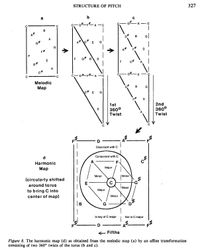
Folgende Abbildung ist aus dem Artikel "Geometrical approximation to the structure of musical pitch" von Roger N. Shepard, veröffentlicht 1982 im Journal der American Psychological Association und beschreibt im Wesentlichen eine kognitive Struktur, deren Transformation mit musiktheoretischen Themen (Oktave, Verschmelzung, Quintenzirkel, etc.) einhergeht. Der Verdichtung in der "Harmonic Map" entspricht in einem Räumlichen Anagramm die axiomatische Krümmung seiner plastischen Form zu einem Korpus.
I have continuously developed my work Spatial Anagrams, with which I completed my degree in architecture at Graz University of Technology (TU Graz) in 2005 under Professor Hirschberg at the Institute of Architecture and Media. I finalized the first version of my software in 2009 and presented an initial outline of its theoretical foundations in 2015 at the 5th Annual Conference of the Carl Stumpf Society, held at the University of Music and Performing Arts Vienna.
From the very beginning, the fundamental principle of Spatial Anagrams has been the twisted torus. Similar to a Möbius strip, it gives rise to a three-dimensional mathematical structure. The surface of the torus can be unfolded into a two-dimensional plane.
My presentation at the 5th Annual Conference attracted interest among the specialist audience, as this fundamental principle was already recognized in music theory and had even become a subject of neurological research.
The following illustration is taken from Roger N. Shepard’s article “Geometrical Approximations to the Structure of Musical Pitch”, published in 1982 in a journal of the American Psychological Association. It essentially describes a cognitive structure whose transformations are associated with concepts in music theory, including the octave, tonal fusion, and the circle of fifths. The condensation represented in the Harmonic Map corresponds, in a Spatial Anagram, to the axiomatic curvature through which its sculptural form develops into a coherent body.